DeepSeek
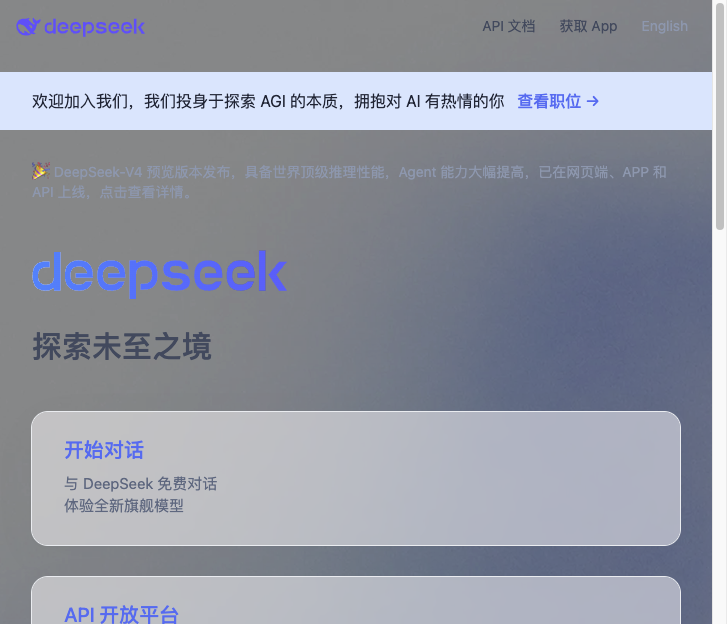
Open-source, high-value Chinese LLMs. The V4 family brings much stronger agent skills, and API pricing remains the cheapest in class.
Last updated by editors:
Our review
DeepSeek has fully entered the V4 era: the official V4.1-Flash release went live on July 31, and the official V4-Pro release arrived on August 12 (model version DeepSeek-V4-Pro-0813, 1M context, up to 384K output). V4-Pro supports thinking/non-thinking modes, the Responses API and Anthropic API compatibility, with a big jump in agent benchmarks (Terminal Bench 2.1: 87.9). The legacy model names deepseek-chat and deepseek-reasoner were discontinued in July, so existing apps need to migrate.
DeepSeek has already flagged an upcoming API price increase; even so, with its famously low pricing (V4-Pro input $0.66/$1.32, output $1.98/$3.96; V4.1-Flash input $0.15/$0.30, output $0.60/$1.20 per 1M tokens, off-peak/peak — peak is 2× on UTC weekdays), it remains the developer value king. The free web and app remain unchanged.
Pros
Cons
Key features
Best for
Who it's not for
Limits to plan for
- The web app is free but can be unstable at peak times
- The API is metered — estimate your own heavy usage
FAQ
What is DeepSeek?
Open-source, high-value Chinese LLMs. The V4 family brings much stronger agent skills, and API pricing remains the cheapest in class.
What are the pros and cons of DeepSeek?
Pros: Strong performance, Open-source & deployable, Strong Chinese, Affordable. Cons: Smaller ecosystem than ChatGPT, Some features immature, Weaker multimodal ecosystem.
How much does DeepSeek cost?
Free: Free; API: Pay as you go.
Who is DeepSeek for?
Best for Chinese chat, Coding, Academic research, Local deployment.
What are the alternatives to DeepSeek?
Consider ChatGPT, Claude, 通义千问.
Pricing
- • Basic chat
- • Limited usage
- • Full features
- • High concurrency
Similar tools
Matched automatically from category and tags, for comparison only.